

3D printing is transforming medical device production at an unprecedented pace. However, this shift is not simply about speed. It is about precision, personalization, and a fundamental improvement in the quality of patient care. Therefore, understanding the latest developments in this space is essential for engineers, hospital procurement teams, and medical device manufacturers alike.
A Market in Full Expansion
The numbers tell a compelling story. In 2026, the global 3D-printed medical device market is valued at approximately $5.27 billion, and it is projected to surpass $20 billion by 2034, growing at a compound annual rate of over 18%. Additionally, the US market alone has grown from $1.66 billion in 2025 to $1.92 billion this year. This growth rate signals that 3D printing in healthcare has moved well beyond experimental territory and into mainstream production.
Furthermore, hospitals and clinics now represent the largest end-user segment, accounting for nearly 48% of the market in 2026. A growing number of modern medical centers have established dedicated in-house 3D printing labs to produce anatomical models that allow surgeons to visualize and rehearse complex procedures before entering the operating room. As a result, this point-of-care production model is fundamentally reshaping medical device supply chains.
Four Core Printing Processes for Medical Applications
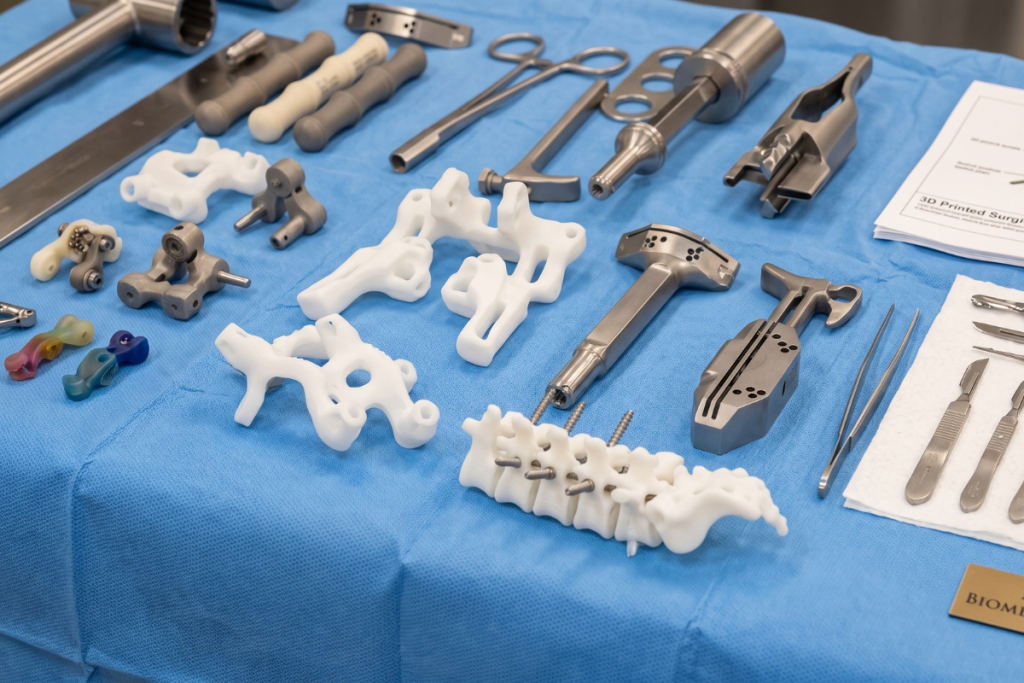
In medical tool manufacturing, engineers typically rely on four main 3D printing processes. However, each process has its own specific use cases and limitations.
Stereolithography (SLA) offers the highest precision, with tolerances as tight as ±0.05 mm. It is therefore well suited for surgical guides, concept models, and fine-featured components requiring smooth surfaces. Medically relevant materials include polycarbonate and silicone.
Selective Laser Sintering (SLS) excels at producing durable parts with complex geometries, with tolerances of approximately ±0.25 mm. It commonly uses nylon and TPU materials, making it a strong choice for functional prototypes and intricate medical components.
Multi Jet Fusion (MJF) delivers a balance of strength and consistency, with tolerances around ±0.30 mm. It is particularly well suited for end-use medical parts in production volumes. Moreover, MJF’s isotropic properties ensure uniform mechanical performance across all orientations—a critical advantage for medical applications.
Direct Metal Laser Sintering (DMLS) is the go-to process for metal medical tools, achieving tolerances of ±0.076 mm. It supports high-strength, biocompatible materials such as titanium, stainless steel, and cobalt chrome, making it ideal for demanding surgical instruments and implants.
Balancing Strength and Aesthetics in Medical Design
From a design perspective, medical tool developers face the same core challenge as all 3D printing engineers: how to balance mechanical performance with surface quality. In a medical context, however, this challenge becomes more nuanced. Surface finish not only affects appearance—it directly impacts the effectiveness of sterilization and overall safety of use.
In additive manufacturing, features that improve strength do not always align with those that improve appearance. For example, thicker walls increase stiffness and durability but can introduce sink marks or visible layer lines. Reinforcement features such as ribs and gussets improve load-bearing performance but may affect surface uniformity. In addition, layer-based processes like FDM produce anisotropic strength, meaning parts perform differently depending on the direction of load.
For this reason, post-processing should be considered as part of the overall design strategy from the outset, rather than as a last step. Vapor smoothing, for instance, significantly reduces surface roughness on nylon components without compromising their strength or durability. Consequently, parts can meet both functional requirements and production-level aesthetics simultaneously.
Three Key Application Areas
Customized surgical instruments: Traditionally, surgeons had to select the closest available instrument from a standard catalog. 3D printing changes this entirely. Engineers can now test new geometries faster and produce forceps, clamps, and retractors tailored to a specific procedure or a surgeon’s individual preference. Furthermore, small adjustments to grip, balance, or weight can make tools significantly easier to control during long or delicate procedures.
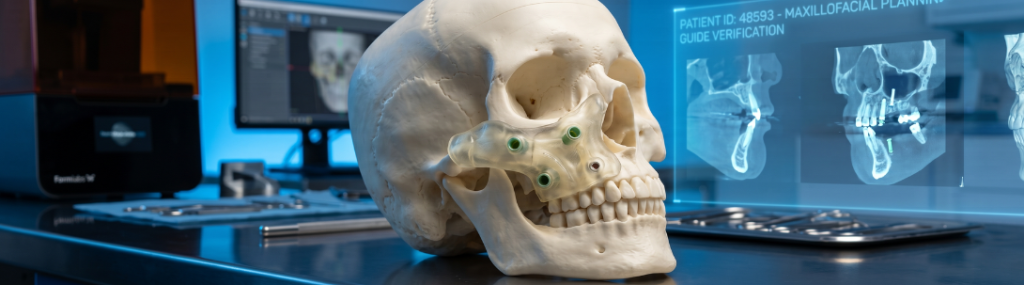
Patient-specific surgical guides: No two patients share the same anatomy. 3D printing makes it practical to produce custom guides based directly on a patient’s CT scan data, supporting more precise placement, alignment, and surgical approach. CT-to-CAD-to-print workflows are increasingly enabling medical teams to turn patient imaging into anatomy-specific cutting guides and drill guides before a surgery even begins.
Custom hospital fixtures and equipment: For highly specialized functional parts that are too niche for mass production — such as positioning aids, test fixtures, or replacement components — 3D printing offers a fast and flexible alternative. Additionally, distributed manufacturing networks bring specialized medical tools within reach of healthcare settings that previously had limited access to custom equipment.
Metal Printing and Material Breakthroughs
One of the most closely watched trends in 2026 is the advancement of metal printing processes. Cold Metal Fusion technology is finding new relevance, while multi-material metal 3D printing is showing exciting potential for both industrial and medical implant applications.
On the materials side, titanium alloys, bioresorbable polymers, and medical-grade ceramics continue to expand their clinical footprint. In particular, porous titanium implant structures—designed to support bone in-growth over time—represent a significant advance in orthopedic medicine. AI-driven inspection tools are also now capable of analyzing every printed layer in real time to ensure dimensional accuracy and reduce waste, bringing a new level of process reliability to regulated medical manufacturing.
Challenges That Cannot Be Overlooked
However, 3D printing in healthcare is not without its obstacles. Engineers must plan carefully around the following realities.
Regulatory compliance: Medical applications typically require strict documentation, process validation, and compliance planning. Requirements vary significantly across regions, which adds complexity to global production strategies.
Material limitations: Not every printable material is suitable for sterilization, skin contact, or demanding clinical environments. For implant-grade or high-temperature sterilization requirements, machining or injection molding may still be necessary.
Quality control: Production-level use depends on documented process parameters, post-processing validation, and inspection workflows that hold consistently across every build—particularly for regulated devices.
Production economics: 3D printing is highly effective for low volumes and high-mix runs. In contrast, once identical part quantities reach a certain scale, injection molding or machining often deliver lower per-unit costs. Therefore, carefully evaluating production volume against process selection is a critical step in cost planning.
Scaling from Prototype to Production
As designs transition from prototyping to production, consistency becomes the primary focus. Material behavior, process stability, and repeatability all determine whether a part can be reliably manufactured at scale.
Technologies such as MJF are well suited for production environments, offering consistent mechanical properties and surface quality across batches. These processes support tighter tolerances and reduce variability—both of which are critical for end-use parts and assemblies. Moreover, designs that account for both performance and appearance from the outset require fewer adjustments during validation. As a result, they are more likely to meet production requirements without significant redesign, which is especially important in medical device development where design changes can trigger new rounds of regulatory validation.
Final Thoughts
3D-printed medical tools represent a faster, more flexible approach to developing equipment for specific procedures, specific patients, and specific clinical needs. As regulatory frameworks mature, material science continues to advance, and AI-assisted quality control becomes standard practice, 3D printing is positioned to evolve from a niche capability into a routine tool for personalized care.
For engineers and medical device manufacturers, now is the time to invest in understanding and leveraging this technology. Selecting the right process and material combination, integrating post-processing into the design strategy, and building compliance awareness from the start—these three priorities will define who leads in the next chapter of medical manufacturing.