

The jewelry industry has relied on traditional craftsmanship for centuries. However, 3D printing is now reshaping every stage of the design and production process. From concept sketching to final casting, this technology is unlocking possibilities that were once unimaginable for jewelers of all scales.
From Sketch to Reality — Faster Than Ever
Traditionally, turning a jewelry concept into a physical prototype required skilled wax carvers or model makers. The process could take days or even weeks. As a result, designers were forced to commit to a single direction before fully exploring alternatives.
3D printing changes this entirely. Designers can now iterate rapidly in digital software and produce a physical prototype within hours. Furthermore, they can test multiple design variations side by side at minimal cost. This speed advantage alone is transforming how collections are developed and presented to clients.
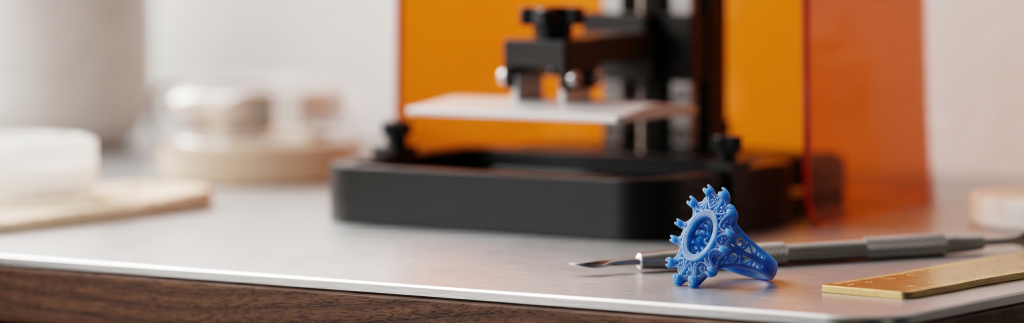
Precision That Human Hands Cannot Match
Fine jewelry demands exceptional accuracy. Even the smallest inconsistency in prong placement, for example, can compromise both aesthetics and structural integrity. Traditional hand carving, however skilled, introduces human variation.
3D printing produces parts with tolerances measured in microns. Therefore, every ring shank, every setting wall, and every decorative detail is reproduced exactly as designed. Additionally, complex geometric structures — such as interlocking lattices, hollow forms, and undercuts — become achievable without the limitations of hand tools.
Democratizing Custom Jewelry
Custom jewelry was once a luxury reserved for clients willing to pay premium prices for one-off artisan work. In contrast, 3D printing has made customization accessible at scale. A small studio can now offer fully personalized engagement rings, name pendants, or birthstone settings without significantly increasing production costs.
As a result, independent jewelers and online brands are competing with established houses in ways that were not possible a decade ago. Moreover, clients can visualize and approve their designs digitally before any material is committed, reducing errors and returns.
Lost-Wax Casting Reinvented
The lost-wax casting method has existed for thousands of years. However, 3D printing has given it a powerful upgrade. Instead of hand-carving a wax model, jewelers now print directly in castable wax or resin. The printed model then follows the same traditional investment casting workflow that jewelers have always used.
This hybrid approach preserves the metallurgical quality of cast precious metals while introducing the precision and repeatability of digital fabrication. Furthermore, it makes high-complexity designs — impossible to carve by hand — entirely viable for production.
Reducing Waste, Reducing Cost
Precious metal is expensive. Traditional subtractive methods, such as milling and filing, generate material waste that adds up quickly. 3D printing, by contrast, is an additive process that uses only the material required to build the object.
Additionally, failed prototypes no longer mean wasted gold or silver — they mean a reprinted wax model worth a fraction of the cost. Therefore, studios can experiment more freely, take on riskier designs, and pass savings on to their customers.
Enabling New Aesthetics
Some of the most exciting changes brought by 3D printing are purely aesthetic. Organic flowing forms, mathematically derived surface patterns, micro-textures, and internal cavities are now design tools rather than theoretical concepts. In contrast, traditional manufacturing methods imposed hard constraints on what shapes were achievable.
As a result, a new visual language is emerging in contemporary jewelry — one that blends digital precision with organic complexity. Furthermore, designers are drawing inspiration from architecture, biology, and generative algorithms to create pieces that would have been technically impossible just fifteen years ago.
The Future Is Accessible
3D printing is not replacing the jeweler. However, it is redefining what the jeweler can do. Studios that embrace this technology are producing higher-quality prototypes, offering broader customization, and bringing complex designs to market faster than ever before. Additionally, as material science continues to advance, the gap between printed prototype and finished product continues to narrow.
Hyperlab3D Now Offers Castable Wax — Starting at Just $1.50/g
Hyperlab3D has just opened up its castable wax material to jewelry makers and studios. This is a significant development for the industry, because high-quality castable wax has historically been a barrier to entry for smaller operations.
With pricing starting at $1.50 per gram, Hyperlab3D makes professional-grade wax printing accessible to independent designers, boutique studios, and prototyping teams alike. The material is fully compatible with traditional lost-wax investment casting workflows, so there is no need to overhaul existing production processes.
Whether you are producing a one-off custom piece or sampling a new collection, Hyperlab3D’s wax opens the door to faster iteration and higher-fidelity prototypes at a cost that finally makes sense for businesses of every size.
Ready to get started? Visit hyperlab3d.com to learn more about the new wax material and place your first order.