

If you’re working in aerospace, defense, or industrial manufacturing, you already know the pain: you need strong, lightweight parts, but traditional 3D printing materials are either too slow or too weak for functional applications. That’s changing fast. In November 2025, Aether launched RapidPrint—a new polymer filament line that promises up to 5X faster print speeds without sacrificing mechanical properties. For engineers and manufacturers chasing tight deadlines and demanding applications, this could be a game-changer.
What Makes RapidPrint PA6 CF10 Different
The first commercial product in the RapidPrint line is PA6 CF10 ABX—a modified polyamide 6 (PA6) reinforced with 10% carbon fiber. That’s significant because traditional carbon-fiber-reinforced nylons have long struggled with printability. They require high temperatures, can clog nozzles, and often produce rough surface finishes. RapidPrint solves these problems with what Aether calls “optimized flow dynamics”
What does it actually change?
Traditional carbon fiber nylons typically print at speeds of 30-60 mm/s. Go faster, and you risk delamination, voids, and weak layer adhesion. The material simply can’t flow fast enough to keep up with high-speed print heads. This limitation has kept carbon fiber reinforced nylons in the “slow but strong” category—great for functional parts when you have time, but frustrating when you need volume.
RapidPrint changes this equation. The material prints effortlessly between 50 and 250 mm/s—that’s a range that matters. At the lower end (50 mm/s), you get industrial-grade strength comparable to traditional carbon fiber nylons. At the upper end (250 mm/s), you’re producing parts 5X faster than conventional high-performance filaments. This speed gain doesn’t come from pushing the printer harder; it comes from the material’s ability to flow cleanly and bond properly even at high throughput.
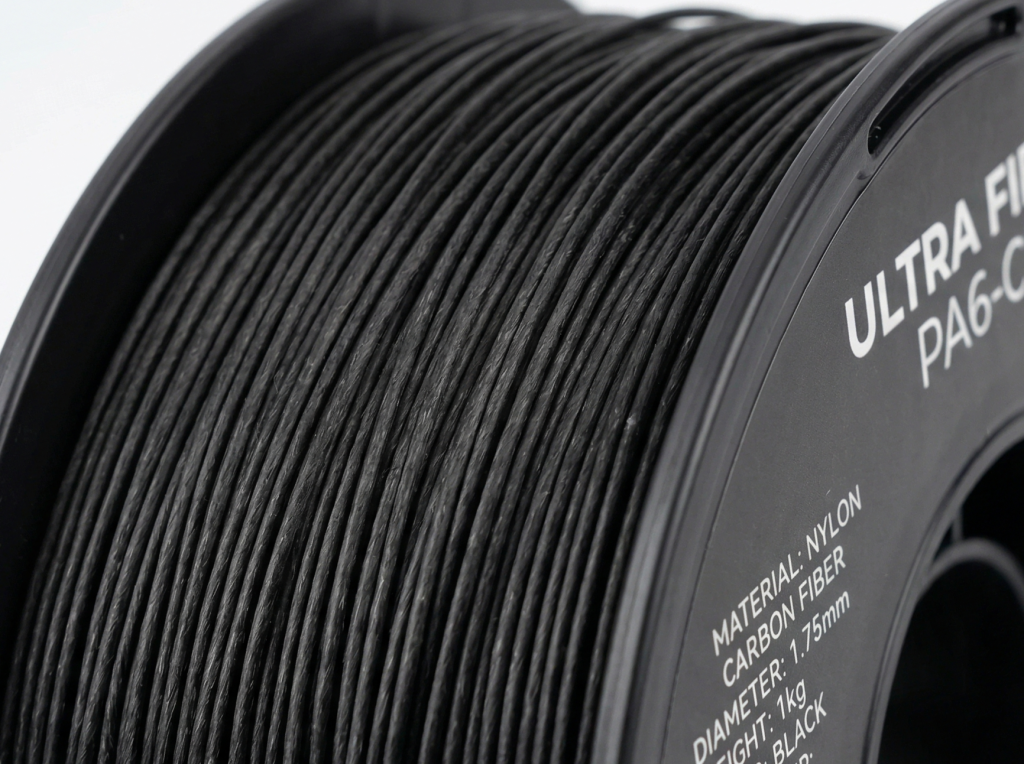
The key innovation here is the “ABX” formulation—a proprietary blend that improves melt flow without compromising the mechanical properties that make PA6 desirable in the first place. Carbon fiber reinforcement adds stiffness and strength, while the modified polymer matrix allows for consistent extrusion across a wider temperature range.
Why Speed Matters for Aerospace and Defense
Here’s where this gets interesting for real-world applications. Defense manufacturers—particularly drone companies—are increasingly adopting additive manufacturing for agile iteration, limited-run production, and field repairs. Every design cycle matters when you’re iterating on a new drone frame or replacement bracket. If your 3D printing process takes 4 days instead of 20 hours, your development timeline stretches by weeks.
The economics are compelling. In drone manufacturing, lightweight structural components directly translate to longer flight times and better performance. Carbon fiber reinforced parts have been the go-to solution, but the slow print speeds have been a bottleneck. With RapidPrint, manufacturers can now produce functional carbon fiber parts in hours instead of days—without compromising the strength-to-weight ratio that makes these materials valuable.
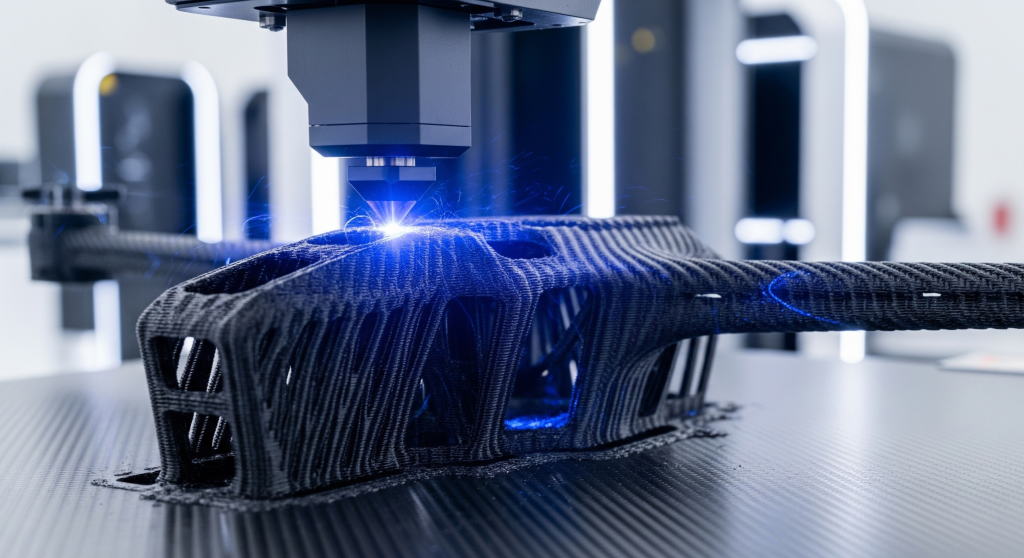
But it’s not just about speed. RapidPrint’s speed gains translate directly into higher rate production, shorter development cycles, and greater supply chain resilience—all without sacrificing the mechanical properties that functional parts require. We’re not talking about prototypes here; we’re talking about end-use parts that need to hold up under real stress. The material is designed for production-grade applications where strength, weight, and durability matter.
The aerospace industry is paying attention. According to industry reports from Formnext 2025, there’s growing interest in materials that can bridge the gap between prototype-friendly filaments and production-grade engineering thermoplastics. RapidPrint fits squarely in that intersection—fast enough for iterative development, strong enough for functional deployment.
Printer Compatibility: Working With What You Have
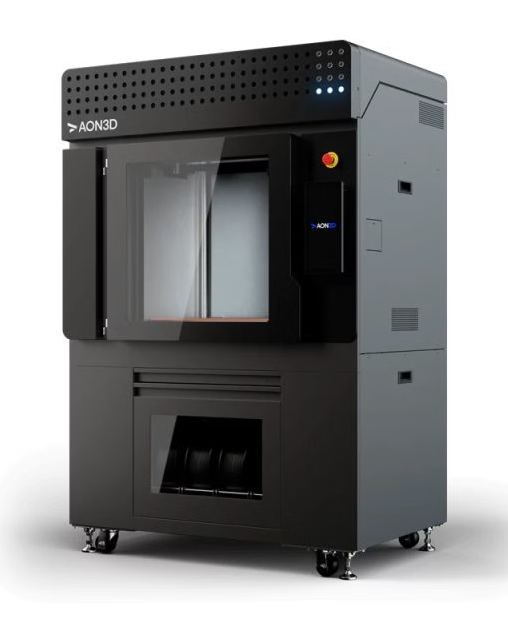
One of the most practical aspects of RapidPrint is its broad printer compatibility. Aether demonstrated the filament on AON3D’s Hylo printer at Formnext 2025, but the material is engineered to work across a wide range of industrial 3D printing systems.
This matters because most manufacturers aren’t running a single printer. They have mixed fleets—some desktop machines for quick prototypes, some industrial systems for production runs. A material that requires specialized hardware limits adoption. RapidPrint’s formulation allows it to perform well on both, which means you can integrate it into your existing workflow without significant equipment investment [Source: VoxelMatters, November 16, 2025]. The material’s broad temperature tolerance (it prints successfully across a range of nozzle temperatures typical of open-frame 3D printers) reduces the trial-and-error that usually comes with new high-performance materials. For manufacturers, that means faster onboarding and less waste during material transitions.
What This Means for Your Next Project
If you’re currently using standard PA12 or glass-fiber-reinforced materials, RapidPrint PA6 CF10 is worth evaluating. The combination of faster print speeds, better mechanical properties, and broader printer compatibility makes it a strong candidate for:
- Drone frames and structural components: Lightweight, strong parts that can be produced rapidly for iterative testing
- Aerospace brackets and fixtures: Functional parts that need to withstand real-world stresses
- Industrial functional parts: Components that require the strength-to-weight ratio that only carbon fiber can provide
- Any application where development cycles are compressed: When speed to functional part matters
The key question is simple: do you need parts that are both strong and fast to produce? If yes, this material was built for you. As more manufacturers adopt high-performance additive manufacturing, materials like RapidPrint are closing the gap between “good enough for prototypes” and “ready for production”.
Looking ahead, Aether has announced that RapidPrint is just the beginning. The company’s Ultra Series, previewed at Formnext 2025, promises additional high-strength polymer filaments for even more demanding applications. For the additive manufacturing industry, the message is clear: the materials that power production are evolving fast, and staying current isn’t optional—it’s a competitive necessity.
Ready to explore high-performance materials for your project?
We specialize in delivering functional parts with advanced materials and fast turnaround. Whether you need rapid prototypes or production-grade components, our team can help you select the right material for your application. Contact us for a quote on your next project—or browse our 3D printing services to see what’s possible with modern additive manufacturing.