

What if you could control exactly how strong or flexible a 3D-printed part is—not by changing the material, but simply by adjusting the light?
That’s exactly what researchers at the Savannah River National Laboratory (SRNL) have achieved with a new technology called CRAFT (Lithographic Crystallinity Regulation in Additive Fabrication of Thermoplastics).
This breakthrough allows scientists to program material properties like strength, flexibility, and durability directly into a 3D-printed part during the printing process—using nothing more than a single light source.
But CRAFT is just one piece of a much larger puzzle. In 2026, the 3D printing industry is experiencing a material revolution — from AI-driven generative design to bioprinting breakthroughs. Let’s explore what’s happening now.
CRAFT Technology: Material Property Simulator
Adjust the light intensity slider to see how it affects the molecular structure and physical properties.
Material State
Molecular Layout
Amorphous〰️〰️
The Problem with Traditional 3D Printing
Until now, 3D printed objects have been essentially “one-note.” The entire part has uniform material properties from top to bottom.
If you printed a plastic bracket, it was equally stiff throughout. If you printed a flexible glove, it was equally flexible everywhere. Traditional 3D printing offered no way to create parts with varied properties in a single print job.
“We’ve never had this level of control over these materials before,” said Sam Leguizamon, SRNL researcher and project lead for the technology. “Being able to direct how polymers form during printing gives us a powerful new tool not just for manufacturing, but for advancing the entire field of polymer science.”
How CRAFT Works: Light as the Control Knob
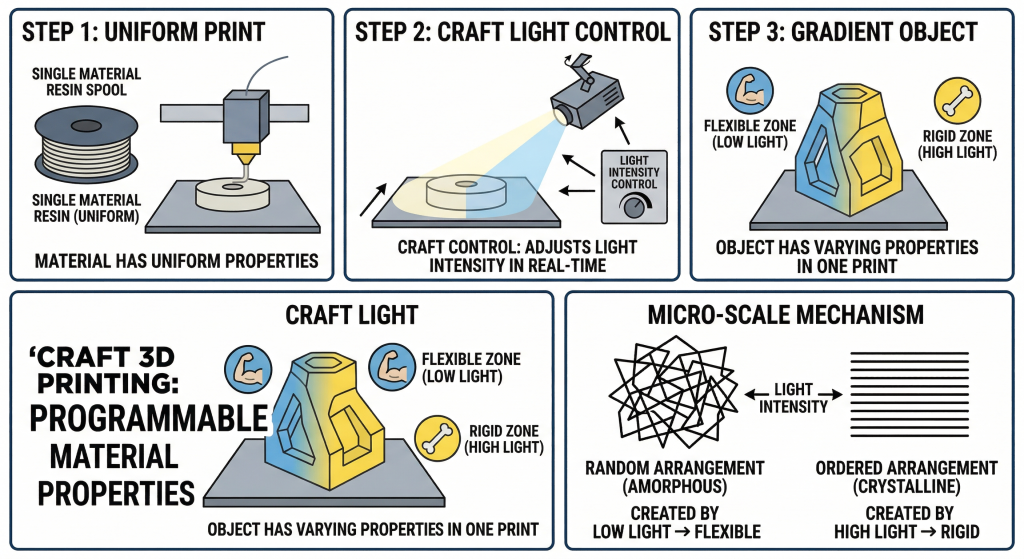
CRAFT changes this by manipulating the molecular structure of polymers in real time using light intensity.
Here’s the key discovery: Simply adjusting the light intensity during printing can force polymers to arrange themselves differently. High intensity might create a section as hard as bone. A quick adjustment to a lower setting, and the very next layer becomes as supple as skin.
The researchers found that light intensity directly alters the material’s molecular structure — a feat usually achieved only with harsh chemicals or extreme heat. By tracking changes in clarity, they proved that light alone could achieve the same complex structural shifts, bypassing existing, more intensive processing methods.
“CRAFT represents a shift in how we think about manufacturing plastic parts,” said Patrick Garcia, SRNL associate lab director. “Instead of accepting materials as they come off the printer, we can now design them with specific material properties for a specific purpose from the very beginning of the process.”
The Bigger Picture: 2026’s Material Revolution
CRAFT is part of a broader wave of innovation reshaping additive manufacturing in 2026. Here’s what’s driving the industry forward:
AI-Driven Generative Design
Artificial intelligence is fundamentally changing how engineers approach 3D printed parts. Generative design algorithms allow engineers to specify parameters like maximum weight, load-bearing requirements, and material types. The AI then generates thousands of optimal geometric structures — designs that are incredibly strong yet exceptionally lightweight.
The combination of generative design plus additive manufacturing is where the most significant performance gains are currently emerging. These AI-driven designs drastically reduce material waste and production time while creating geometries impossible to achieve through traditional manufacturing.
Digital Twin Integration
Another major leap forward involves digital twin technology. By pairing a physical 3D printer with a virtual replica, manufacturers can simulate the entire printing process before a single drop of material is extruded.
- Virtual testing predicts thermal warping and structural weaknesses
- Real-time adjustments occur automatically during the physical print
- The system learns from past prints to improve future accuracy
Multi-Material Printing
Multi-material printing is no longer experimental. In 2026, consumer-grade multi-color hardware is booming, eliminating the need for post-processing and hand-painting. This will be the standard for desktop printers by 2026.
For industrial applications, the ability to print with multiple materials in a single job enables functional prototypes that mimic final product properties — combining rigid structural elements with flexible components.
Real-World Applications
Medical Training Models
Researchers at the University of Texas at Austin put CRAFT to the ultimate test by 3D printing a detailed model of a human hand in a single session.
Typically, creating a realistic medical model requires assembling dozens of different parts from various materials. With CRAFT, the team printed the entire hand in one continuous session using a single material. The result featured rigid internal bones, resilient ligaments, and soft, pliable skin—all in one print.
This capability transforms how surgeons practice complex procedures and how medical students learn anatomy.
Bioprinting Breakthroughs
Bioprinting has moved from the lab to clinical applications. The TRACE (Tunable Rapid Assembly of Collagenous Elements) method developed at Stony Brook Medicine accelerates collagen assembly, enabling researchers to print functional heart and kidney tissue models. These models accurately mimic human physiology, offering a safer and faster alternative for drug testing.
Point-of-Care Manufacturing now allows hospitals to print essential tools, surgical guides, and customized prosthetics right inside the clinical setting, ensuring surgeons have perfectly tailored instruments for complex procedures.
Aerospace and Defense
The technique could enable aerospace engineers to build components that transition from heat-resistant to vibration-absorbing within a single part. For the energy sector, it could help develop high-stress nuclear security systems that are both strong and lightweight.
AML3D recently landed a US Navy contract for obsolete submarine components, demonstrating how 3D printing is becoming critical for defense supply chains.
Large-Scale Additive Construction (LSAC)
The construction industry is embracing 3D printing through Large-Scale Additive Construction (LSAC). This technology lowers construction costs and speeds up build times dramatically. In 2026, we’re seeing more buildings printed on-site, with materials and techniques that offer lower carbon emissions and decreased material waste.-
Why This Matters for Your Business
For 3D printing service providers like Hyperlab3d, these technologies represent the future of additive manufacturing. The ability to create multi-material parts with a single printer opens up possibilities for:
- Functional prototypes that mimic final product properties
- Custom medical devices tailored to individual patient needs
- Lightweight aerospace components with optimized strength-to-weight ratios
- Protective gear with varied flexibility and protection zones
While CRAFT is still in the research phase, it signals a clear trend: the future of 3D printing is not just about geometry—it’s about programmable material properties.
The combination of AI-driven design, advanced materials, and new processes like CRAFT means the industry is evolving faster than ever. Companies that stay ahead of these trends will capture new market opportunities in aerospace, defense, medical, and automotive sectors.
Conclusion
The CRAFT technology developed by SRNL and its partners represents a fundamental shift in how we think about manufacturing plastic parts. By using light to control crystallinity and molecular structure in real time, scientists can now create parts with tailored properties—strong where you need strength, flexible where you need flexibility.
But CRAFT is just one chapter in a larger story. In 2026, the 3D printing industry is experiencing a material revolution: AI generates optimized designs, digital twins predict performance, multi-material printers create functional parts, and bioprinting saves lives.
For industries from aerospace to biomedicine, these innovations open doors that were previously impossible. And for 3D printing service providers, it’s a reminder that the technology landscape is evolving fast.
Stay ahead of the curve. Partner with a 3D printing service provider who understands the latest advancements.