

Harvard researchers have developed a new way to 3D print materials that move on their own—bending, twisting, and contracting without motors or mechanical parts.
—
Introduction
What if materials could move on their own? Harvard researchers have made this a reality. They developed a new 3D printing technique that creates artificial muscles. These muscles can bend, twist, and contract when heated. No motors or traditional mechanical systems are needed.
This breakthrough comes from the lab of Jennifer Lewis at Harvard John A. Paulson School of Engineering and Applied Sciences (SEAS). The research was published in the Proceedings of the National Academy of Sciences.
How 3D Printed Artificial Muscles Work
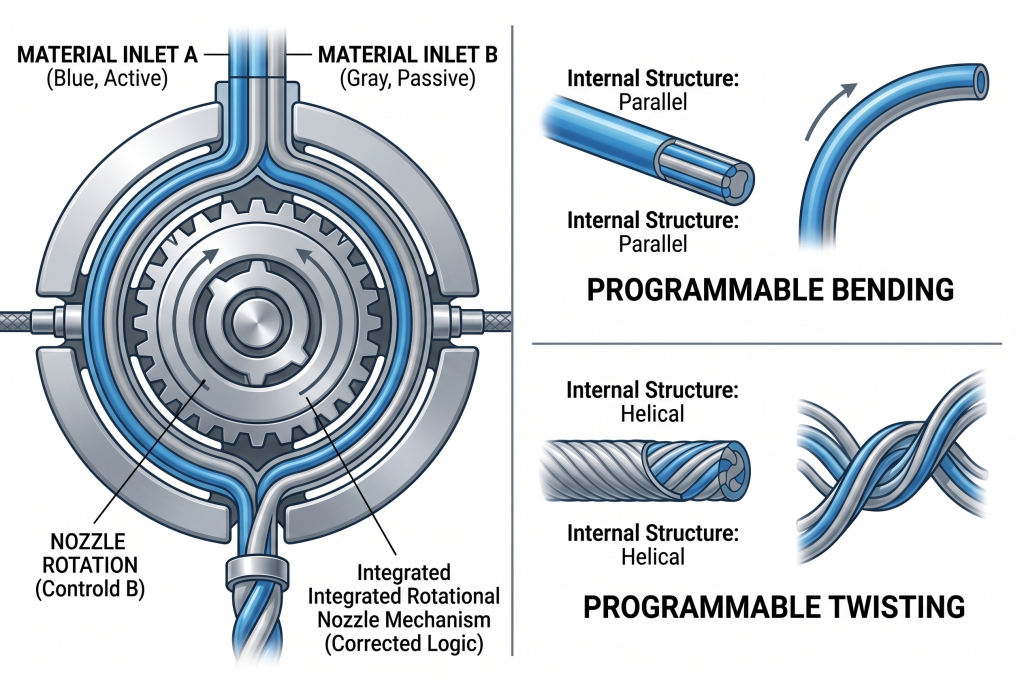
The key is using two materials in one filament. One material shrinks when heated. The other stays the same. Because they react differently, the structure bends or twists when the temperature changes.
The team rotates the print nozzle during fabrication. This creates composite filaments with controlled internal structure. The rotational printing step enables twisting and complex deformation.
Unlike standard plastic extrusion, this method uses direct ink writing. The team places “active” and “passive” materials side by side. By controlling their orientation during printing, they can program how the structure will behave. If layers are aligned one way, the filament bends. If rotated, it twists. This turns the printing process itself into a way of programming movement.
Why Active 3D Printing Materials Matters
Materials like these could be used in several fields. First, soft robotics could benefit. Devices would no longer need motors or hinges. Second, medical devices could adapt inside the body. Third, flexible systems could respond to their surroundings.
Because motion is built directly into the material, there’s no need for complex assemblies. This could make the devices easier to produce and more reliable over time.
The motion is smooth, continuous, and reversible. This is something hard to achieve with traditional rigid components.
The Future of Active Materials
This is not the first breakthrough from the Lewis Lab. The team has been at the forefront of printing functional materials for years. They were early pioneers in bioprinting.
The idea of printing motion into matter opens new possibilities. As the technology develops, we may see more applications in robotics, medicine, and beyond. The future of materials is active, adaptive, and self-moving.
References
[1] Harvard’s Jennifer Lewis Lab Is 3D Printing Artificial Muscles – 3DPrint.com, May 2026
[2] Proceedings of the National Academy of Sciences – PNAS, 2026